


Indian Ocean
Africa’s safari companion.
Mauritius is not defined by its coastline alone, and that is the point of difference worth establishing first. Inland, Black River Gorges National Park protects a substantial stretch of the island's remaining native forest, rising toward a central plateau marked by volcanic features — crater lakes, including Trou aux Cerfs, and a landscape of ridges and waterfalls that has little in common with the image most people carry of an Indian Ocean island.
Combined with its lagoons and an extensive reef system, Mauritius assembles a range of landscape — coast, lagoon, forest, volcanic interior — that neither Zanzibar nor Seychelles brings together in the same place. For a journey's final days, that range is not a compromise. It is the specific thing Mauritius is for.
"For a journey's final days, that range is not a compromise. It is the specific thing Mauritius is for."
Mauritius's flight connectivity makes it the most flexible of the three pairings, with strong direct routes from South Africa in particular — a direct flight from Johannesburg takes roughly four hours, comparable to many long-haul domestic safari transfers — alongside connections across East Africa.
"Where Zanzibar's pairing logic is proximity and Seychelles' is matching the register of a Private & Exclusive itinerary, Mauritius's is range and flexibility."
It suits travellers whose journey has included more than one region, or whose final days need to serve more than one set of preferences at once. This makes it a frequent choice for families and groups completing a longer journey: the stillness that defines this category of pairing is available here as much as on the other two islands, but it sits alongside a wider range of things to do, for those in the group who want them — without that range coming at the stillness's expense.
Interior, coastline, history, and breadth of activity — four distinct threads that together explain why Mauritius assembles range no single-register island can match.
The interior landscape is Mauritius's clearest point of difference. Black River Gorges National Park protects the largest remaining area of native forest on the island, home to species found nowhere else, including several endemic birds that have been the subject of long-running conservation programmes. The central plateau rises through a volcanic landscape of ridges, waterfalls, and crater lakes — Trou aux Cerfs among them — giving Mauritius a vertical dimension neither of the other two islands has.
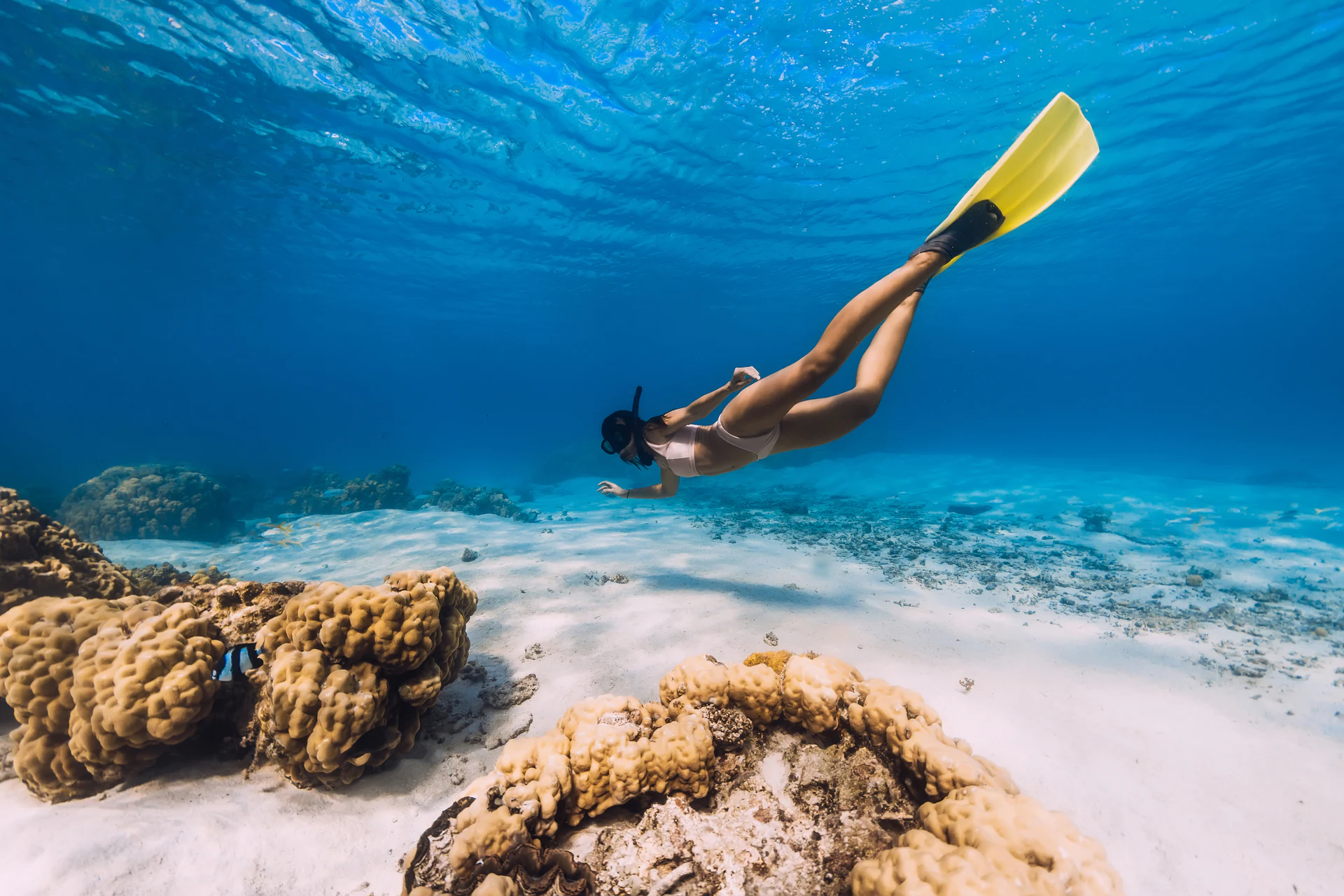
Explore →The coastline operates differently again. Mauritius's lagoons — extensive, shallow, and protected by an almost continuous barrier reef — are a distinct marine environment from Seychelles' granite-bound bays or Zanzibar's open reef, and support their own range of activity, from sailing within the lagoon to diving along the outer reef edge.
Explore →Mauritius's own history — Dutch, French, and British colonial periods, followed by significant Indian and Chinese immigration — has produced a cultural layering of its own: less central to the visitor experience than Zanzibar's, but present in the island's food, language, and architecture for those who look for it. Le Morne Brabant, a UNESCO World Heritage site on the island's south-west coast, carries this history in its most direct form — a mountain that sheltered escaped slaves in the eighteenth and early nineteenth centuries, and a site of genuine historical weight rather than scenery alone.
Explore →The breadth extends to activity more broadly: golf courses designed by recognised names, water sports, and a wider range of dining than either of the other two islands offer. None of this dilutes the stillness that defines this category of journey — it sits alongside it, available to those who want it without being imposed on those who do not.
Explore →Mauritius has a more clearly defined seasonal pattern than Seychelles. The cooler, drier period runs from May to October. The cooler season aligns well with the dry-season safari window across both Southern and East Africa, making it the straightforward recommendation for most pairings.
The warmer, more humid period runs roughly from November to April, including the risk of cyclones within that window. That said, the warmer season still offers strong conditions for travellers for whom water temperature matters more than the cyclone-season caveat — a trade-off worth stating plainly rather than glossing over.
This is the kind of honest detail that helps a traveller decide what matters most for their own journey.
Our Travel Designers select Mauritius properties for the specific itineraries where breadth of experience genuinely adds value — most often families or groups whose final days need to accommodate more than one set of preferences. This is not a default choice or a lesser one relative to Seychelles or Zanzibar; each of the three islands earns its place for a particular kind of journey, and Mauritius's is range.
A property selected here is chosen for how well it delivers that range — landscape, activity, and stillness together — without losing the standard of privacy and service the traveller experienced throughout the safari. In practice, this often means weighing a property's position on the island as carefully as its facilities: a lagoon-facing estate suits a group prioritising water-based activity, while a property closer to the interior offers easier access to Black River Gorges and the central plateau for those who want the landscape argument to be part of their stay, not just their view.
For a journey whose final days need to offer something for everyone — without losing the stillness the rest of the trip has been building toward — Mauritius is often the right answer.