


Where South Africa, Zimbabwe and Mozambique meet — fever-tree forest, 350+ birds, and one of Africa's most significant land-restitution conservation stories.
At the point where the Luvuvhu and Limpopo rivers converge — where South Africa, Zimbabwe, and Mozambique meet within sight of one another — the landscape produces something no other section of Kruger can replicate. Two river systems at different ecological temperatures create a microclimate that supports fever-tree woodland, mopane scrub, and dense riverine forest within a few kilometres of each other. The outcome is a bird count — more than 350 recorded in the Pafuri area — that no comparable stretch of land elsewhere in South Africa approaches.
This is the Makuleke Contractual Park: roughly 24,000 hectares of northern Kruger returned to the Makuleke community through South Africa's post-apartheid land-restitution process, and retained as part of the national park under a contractual agreement that has become one of the most studied conservation-governance models on the continent. Most visitors to the South African circuit spend their time considerably further south. Very few reach Pafuri. Those who do tend to return.
“Most operators name the camps. SafariSeven® explains the context.”
In 1969, under apartheid-era legislation, the Makuleke people were forcibly removed from roughly 24,000 hectares they had occupied for generations in what is now the far northern corner of Kruger. The community was relocated south; the land was absorbed into the park; no mechanism for return existed. Twenty-nine years later, that changed. In 1998, the Makuleke won the first successful land claim within a South African national park — a legal milestone without precedent in the country's conservation history.
The Makuleke chose to retain the land as wilderness rather than convert it to other use. That decision is not incidental to the experience of visiting this place. It is its foundation.
The settlement was structured as a contractual park: the Makuleke retain full legal ownership of the 24,000 hectares; SANParks continues to manage the area as part of Kruger; and tourism revenue flows back to the community through a jointly administered programme. The result is a model studied internationally precisely because it resolved a conflict — between land rights and conservation — that most countries have failed to resolve at all. A guest here occupies land whose ownership, management, and economic benefit are structurally connected to one of Africa's most significant restitution stories.
Pafuri is not a Big Five destination in the sense that the Sabi Sand or Timbavati are — and that distinction is precisely what makes it worth understanding. Nyala are present in significant numbers, drawn to the dense riverine woodland; sable antelope and eland, rarely encountered in southern Kruger, appear with greater frequency. Elephant herds use the Luvuvhu corridor as a seasonal movement route between countries. Leopard are present within the dense riverine cover — sightings earned rather than frequent, and carrying a different weight for it — while crocodile and hippo are year-round residents of the perennial river. The baobab forest near Crooks' Corner, with trees exceeding 1,000 years, is worth the journey independently of anything else.
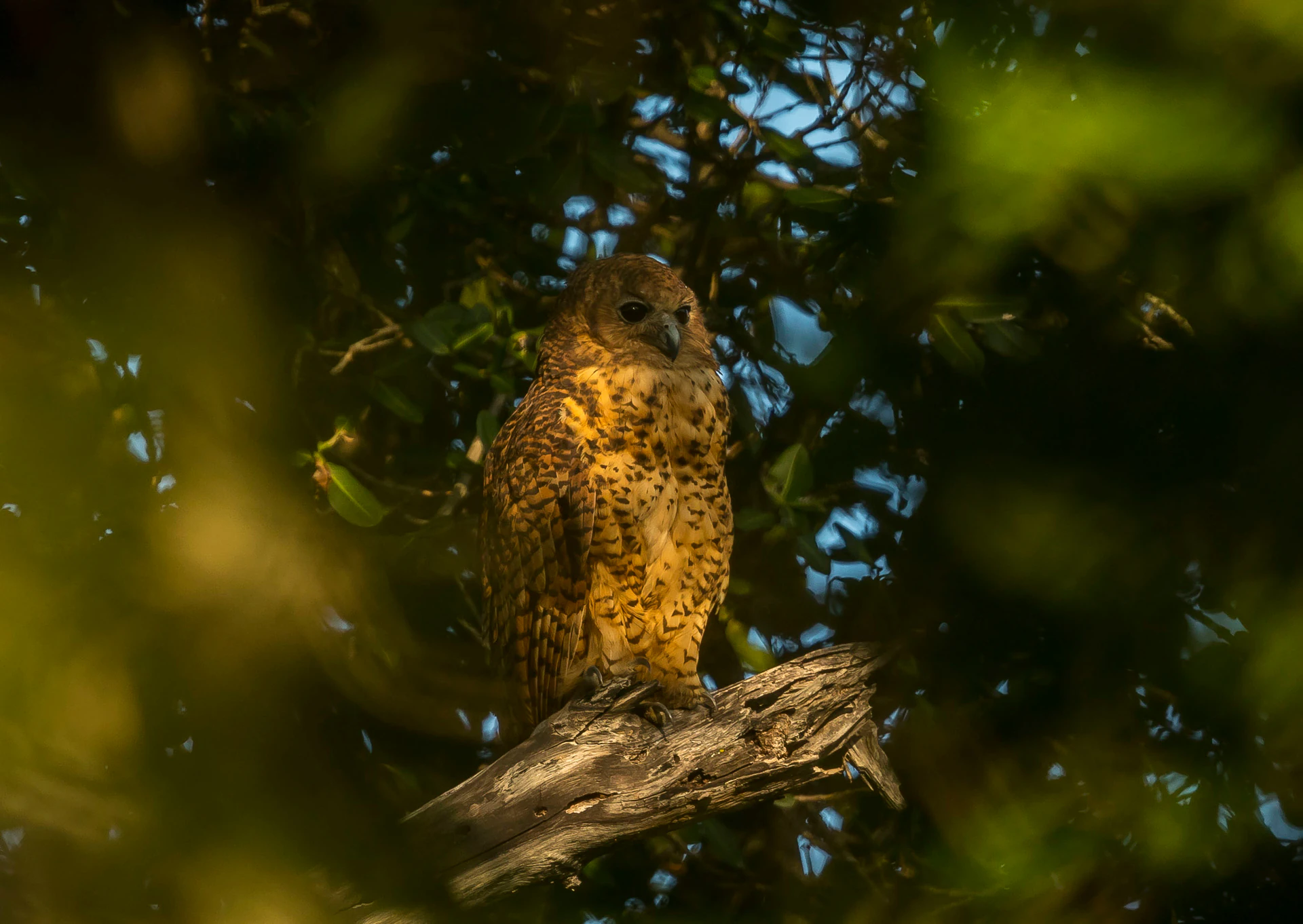
More than 350 bird species have been recorded here — the stacking of riverine forest, sand forest, fever-tree woodland, and mopane scrub in a small footprint is the explanation, not simply the latitude. Pel's fishing owl is the bird that draws serious birders to Pafuri specifically: this large, rufous owl roosts in riverine fig and jackalberry forest along the Luvuvhu and offers the most consistent opportunity in South Africa for a species much of the birding world has carried at the top of a wish list for years.
The Narina trogon is almost always heard before it is seen; the African finfoot navigates the quieter stretches of the river; racquet-tailed roller, broad-billed roller, and Böhm's spinetail are specific target species that informed travellers plan long journeys to find. Migratory arrivals between October and April expand diversity further, at the cost of denser vegetation and higher temperatures; the dry season produces clearer sight lines and superior mammal observation.
The lodges operating within the Makuleke Contractual Park do so under a framework where community benefit is not aspirationally promised but legally embedded in the contractual agreement. This is materially different from a privately operated concession — the revenue architecture is structured differently, and that difference is worth understanding before arrival. Properties here are consistently small, typically fewer than twenty guests, and positioned in close relation to the Luvuvhu. Beyond the game vehicle, activities extend to guided river walks, specialist pre-dawn birding, night drives, and stargazing from a location with almost no light pollution.
Access is remote in the honest sense: the nearest major airports — Kruger Mpumalanga International or Phalaborwa — are followed by long road transfers, or a light aircraft into the Pafuri airstrip. Travellers who require easy access, minimal transit, or high wildlife density in a compact area should consider other parts of the South Africa cluster. Pafuri is calibrated for those who bring patience and ecological curiosity in roughly equal measure.
Wildlife concentrates along the Luvuvhu as water elsewhere diminishes. Vegetation thins to the point where extended game-drive visibility becomes reliable, and the cooler ambient temperature — June and July nights in the far north can be genuinely cold — produces conditions most mammal-focused and photographic travellers prefer.
Late September warms considerably; the final weeks carry heat that warrants honest mention when planning.
The landscape transforms in ways the dry season cannot produce: extraordinary afternoon light, dense greenery, and thunderstorms of genuine spectacle. Migratory bird species arrive in numbers, and the quality of solitude — lower vehicle counts, a bush that feels untrafficked — is different from anything in the southern African winter.
Midday temperatures between November and February regularly exceed 40°C. That is not a comfortable environment for travellers unprepared for serious heat.
Both months offer a practical middle point: October delivers the last of the dry-season wildlife concentration alongside the first summer migrants; April combines the tail end of birding diversity with improving game-drive conditions as the vegetation begins to recede. Temperatures in both are more manageable than midsummer and make for strong field days when conditions cooperate.
Pafuri works best as a considered chapter within a longer South Africa journey — the ecologically serious opening or close of an itinerary that draws meaning from contrast.
Community conservation and earned encounters in the far north; leopard density and refined accommodation in the south. Each makes the other more legible.
Explore Sabi Sand →A journey that opens in the far north and closes at the Cape operates at radically different scales and tempos. The contrast is the point.
Explore Cape Town →We recommend Pafuri for a specific kind of traveller: one who has already seen the standard South Africa circuit and wants to understand what else this country holds, or who arrives with an ecological or conservation interest that conventional itineraries do not serve. The 24,000 hectares of the Makuleke Contractual Park represent not just exceptional wilderness but one of Africa's most significant conservation-governance stories. That story is worth understanding before you arrive — and understanding it changes the quality of what you observe once you are there.
Pafuri is not for everyone, and we say so honestly to every client who raises it. It requires patience over the guarantee of sightings, remoteness over convenience, and a genuine tolerance for heat in the summer months. But for the traveller who arrives correctly prepared — with time, curiosity, and an interest in the full story of who owns this land and why — Pafuri delivers something the more trafficked destinations of South Africa cannot: the only safari destination in the country where the conservation outcome and the human-rights story are inseparable.
Pafuri asks for patience, curiosity, and time — and rewards them with something found nowhere else in South Africa. If that is the journey you want, we would welcome the conversation.