


Two ecosystems, one extraordinary conservation story.
Rwanda arrived at its current standing as a safari destination through a deliberate national commitment of a kind most countries have never attempted. In the volcanic foothills along its northwestern border, mountain gorilla numbers that once threatened to slip beyond recovery have grown to over a thousand individuals across the broader Virunga landscape — a result not of chance but of sustained political will, community investment, and scientific rigour spanning five decades. In the east, a national park once systematically emptied of its apex predators has been methodically restored to a functioning Big Five ecosystem within a single decade.
These are not incidental tourism stories. They are the strongest available argument that conservation and travel, properly aligned, can restore what appeared to be permanently lost — and that the most meaningful wildlife encounters are often those that carry the weight of a recovery.
"The most meaningful wildlife encounters are often those that carry the weight of a recovery."
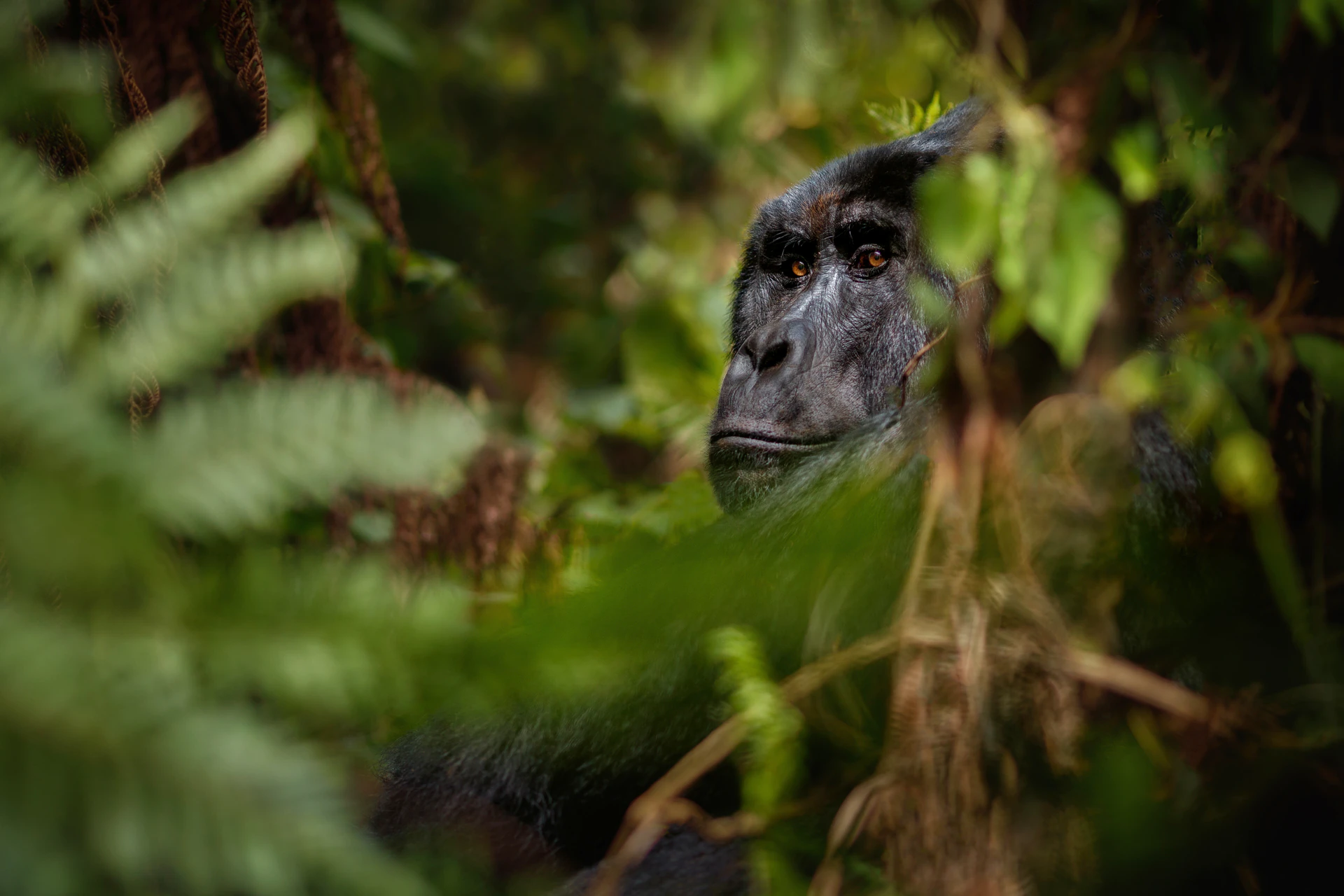
The mountain gorilla encounter in Volcanoes National Park draws most travellers to Rwanda first, and it deserves that reputation. The experience is unlike any other wildlife encounter on the continent — physically immersive, emotionally unpredictable, and quietly profound in ways that resist easy description. Rwanda's management of this encounter is among the most refined in East Africa: trekking routes are generally shorter than those in Uganda's Bwindi Impenetrable Forest, lodge quality in the Virunga foothills has reached a standard that compares with the finest properties in Southern Africa, and the permit and tracking infrastructure is precisely organised. None of this diminishes the wildness of what happens in the forest. The gorillas are encountered on steep volcanic slopes, in dense montane vegetation, in conditions that remind every person who attempts the approach that this experience is earned.
"What Rwanda offers the discerning traveller is rarity managed with unusual intelligence."
The national government has made a deliberate choice to limit gorilla permit numbers, price access at a level that funds conservation directly, and reinvest tourism revenue into both habitat protection and community benefit programmes. The gorilla permit — currently USD 1,500 per person — is not arbitrary. It is the mechanism by which the mountain gorilla continues to exist.
Akagera National Park, in the east of the country, represents an entirely different ecological register. The landscape opens into rolling savannah, papyrus-fringed lakes, and open floodplains — a lakeland mosaic that bears more ecological resemblance to the accessible savannahs of western Tanzania than to the mountain forests of the Virungas. Under African Parks co-management from 2010, the park was fundamentally transformed: lions were reintroduced from South Africa in 2015, black rhinoceros followed in 2017, and Akagera now supports a complete Big Five ecosystem. The quality of wildlife viewing here is consistently underestimated by travellers who arrive in Rwanda focused solely on the gorillas.
Together, Volcanoes and Akagera allow Rwanda to support a genuinely two-dimensional itinerary. A journey that moves between montane forest and open savannah — between the close-range intimacy of gorilla trekking and the broader canvas of savannah game drives and lake-based boat safaris — offers ecological and experiential contrast that few countries can provide within such a compact geography. Rwanda is small, well-connected internally, and efficiently navigable: the transfer between the Virunga foothills and Akagera passes through Kigali, a capital city that merits at least a half-day in its own right.
Montane forest and open savannah, within a single compact geography. Together they support a genuinely two-dimensional itinerary.
The mountain gorilla encounter in Rwanda reaches its highest expression in the mist-covered bamboo and Hagenia forests of the Virunga volcanoes. Volcanoes National Park is the most logistically accessible gorilla destination in East Africa, with first-rate lodge infrastructure in the foothills, a well-managed permit system, and trekking routes that, while physically genuine, are achievable for most travellers with reasonable fitness. It is also where Dian Fossey established the Karisoke Research Centre in 1967 — the scientific foundation upon which the conservation model that now protects every mountain gorilla in existence was built.
Explore →Rwanda's only savannah wilderness covers approximately 1,122 square kilometres of eastern lowland, encompassing grassland, miombo woodland, and a chain of papyrus-edged lakes along the Tanzanian border. African Parks' co-management from 2010 delivered the most ambitious predator reintroduction in the country's history: lions in 2015, black rhinoceros in 2017. The park now holds all Big Five species alongside healthy populations of elephant, buffalo, zebra, topi, and waterbuck. Game drives are conducted with a fraction of the vehicle density common in Kenya or Tanzania's busiest parks — the space and privacy are real.
Explore →Mountain gorilla trekking operates throughout the year. The gorillas' range shifts across significant altitude variations within Volcanoes National Park, responding to rainfall, vegetation cycles, and the movement of their food sources.
The two dry periods — June through September and December through January — are broadly considered the most favourable for trekking. Trails are firmer underfoot, vegetation is marginally clearer, and the physical demands of the approach are, on average, more manageable. Lodge availability during both windows is tight, and gorilla permits are allocated weeks or months in advance during peak periods. For travel between June and September particularly, planning six months ahead is not excessive — it is frequently the difference between accessing the experience and missing it entirely.
The long rains, which fall roughly from March through May, and the shorter wet season around October and November, do not prevent trekking. They reframe it. The forest is heavier and more atmospheric in wet conditions. The approach becomes genuinely demanding: steep, muddy, and requiring real physical preparation. Fewer visitors during these periods creates a quieter, more solitary encounter with the forest. The gorillas remain consistently findable, and the quality of the encounter with the family is unchanged once you reach them. For the physically prepared traveller with scheduling flexibility, the wet season has an intensity that the dry season — for all its practical advantages — cannot replicate.
For Akagera, the June to September dry season draws wildlife to the lake margins and open grasslands in greater concentrations, making game drives more productive and the landscape easier to read. The park's wetland mosaic — particularly Lake Ihema — rewards boat safaris throughout the year. The shoebill stork, one of Africa's most singular birds, is most reliably located in the papyrus swamps during wetter months when vegetation patterns suit their behaviour.
Rwanda is the destination we recommend most confidently to travellers who believe they already know Africa. It almost always complicates that assumption — not through scale or spectacle, but through proximity. The gorilla encounter in Volcanoes National Park is genuinely difficult to prepare for: the silence before contact, the stillness of the forest in the final metres before you reach the family, the irreducible fact of an animal that looks back and sees you without alarm. It is not a wildlife sighting. It is something different in kind from almost any other experience the continent offers, and it tends to leave thoughtful travellers reconsidering what they understood a safari to be.
What we value in Rwanda beyond the encounter itself is the coherence of the conservation model. The revenue loop connecting gorilla permits to community benefit funds, ranger programmes, and habitat protection is not a marketing proposition — it is structurally embedded in how Rwanda manages its wildlife assets. Travelling here supports something measurable, and that specificity matters to the travellers we work with most closely.
Akagera earns considerably less of the spotlight than it deserves. We include it in almost every Rwanda itinerary we design — not as an ancillary option but as a genuinely distinct destination that adds ecological range and a different quality of light and landscape to what could otherwise remain a single-story journey. The savannah chapter of Rwanda is not an afterthought. It is the completion of the picture.
Rwanda integrates naturally with Uganda, which shares the Virunga mountain gorilla range and offers a second, distinctly different approach to the gorilla encounter in Bwindi Impenetrable Forest. A Rwanda-Uganda itinerary built around contrasting gorilla experiences — Volcanoes' relative logistical refinement against Bwindi's rawer, more demanding wilderness — is among the most compelling primate journeys available in Africa. The differences between the two encounters are real, specific, and best understood by experiencing both.
Rwanda also connects logically eastward into the Tanzania Northern Circuit, a natural extension for the traveller whose appetite for open savannah scale was sharpened rather than satisfied by the forest encounter. The combination of Volcanoes, the Serengeti, and Zanzibar as a closing chapter covers more of Africa's ecological range than most travellers realise is available within a single journey.
Whether the gorilla encounter or the savannah chapter draws you first, Rwanda rewards the traveller willing to see both. We would welcome the conversation.