


The complete departure. The same private-concession principle, in a landscape unlike anywhere else on earth.
Seychelles is not, geologically speaking, like the rest of the Indian Ocean. The granite islands of its inner group — Mahé, Praslin, La Digue — are built on some of the oldest exposed rock on the planet's surface, fragments of an ancient continental landmass that separated from Africa and Madagascar long before either took the shape they have today.
The result is a landscape unlike anywhere else this journey will have passed through: enormous granite boulders, smoothed by time, standing in forest that reaches directly to the shoreline, producing beaches — Anse Source d'Argent among the most recognisable — defined as much by stone as by sand. After the open horizons of the savannah, this is a landscape of a completely different character, and that contrast is not incidental. For a specific kind of traveller, it is the entire point.
"Seychelles is not so much a change of pace as a continuation of the same principle: genuine exclusivity, in a setting that could not be mistaken for the bush."
Seychelles' pairing logic differs from Zanzibar's. Where Zanzibar's case rests on proximity, Seychelles' rests on register — on matching the scale of what comes before it. Seychelles suits travellers completing a longer or more intensive safari, particularly a Private & Exclusive itinerary across multiple remote concessions, who want a conclusion that does not step down in either privacy or remoteness.
"The island's private island properties — an entire island, one property, a household of staff who know it intimately — offer the same low density and personal attention as a private concession in the Okavango or the Serengeti, transplanted to a different ecosystem."
For travellers on this kind of itinerary, Seychelles is not so much a change of pace as a continuation of the same principle: genuine exclusivity, in a setting that could not be mistaken for the bush.
Geology, remoteness, conservation, and marine richness — four distinct threads that together explain why Seychelles is the most complete departure of the three.
The three principal granite islands each have a distinct character. La Digue moves at the pace its ox-carts and bicycles set — there is little reason, and little room, to move faster. Praslin is home to the Vallée de Mai, a UNESCO-listed forest of palms that includes the coco de mer, whose seed — among the heaviest produced by any plant — grows nowhere else in the wild. Mahé, the largest and most developed of the three, is where most journeys arrive, and where the contrast between developed and undeveloped Seychelles is most visible.
Explore →Beyond the inner islands, the outer islands and a small number of dedicated private island resorts represent the most complete version of remoteness available in this category: a single property occupying an entire island, with no other guests and no shared infrastructure. For travellers pairing with a Private & Exclusive safari, this is the natural conclusion to that kind of journey.
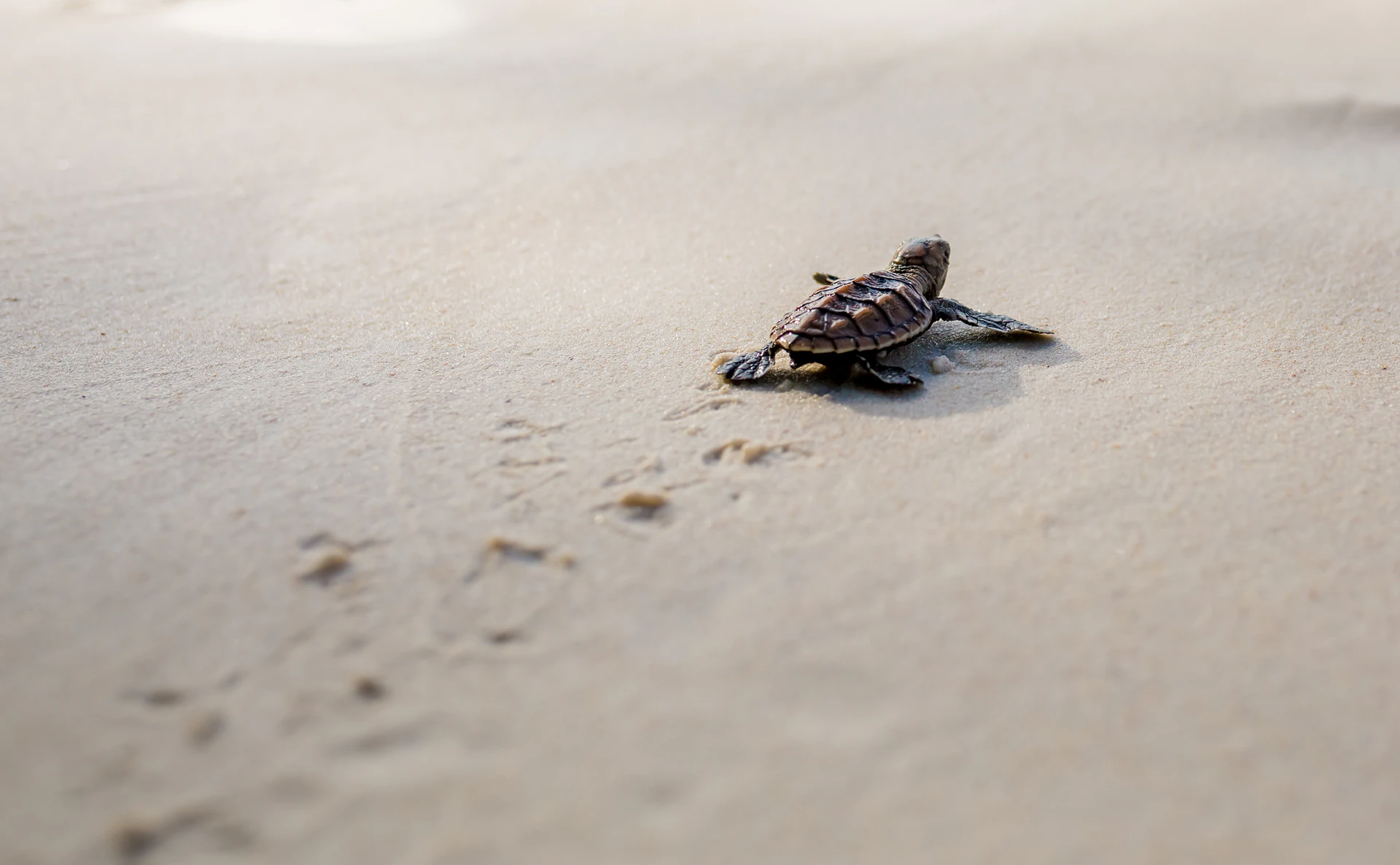
Explore →Conservation runs through this landscape as quietly as it does through the safari that precedes it. Several of Seychelles' islands are sanctuaries for the Aldabra giant tortoise, one of the largest tortoise species in the world and a population that has recovered through sustained protection — a parallel, in a different ecosystem, to the species-recovery work that defines several of SafariSeven's safari partners.
Explore →The marine environment carries the same specificity as the land. Seychelles' reef systems and marine national parks support diving and snorkelling with an ecological richness that, elsewhere on this site, is described with the same reverence reserved for the migration or the Big Five. The stillness here is more total than Zanzibar's — fewer cultural diversions, more genuine isolation — and for the right traveller, arriving at the end of a long safari, that is precisely the value.
Explore →Seychelles sits close enough to the equator that its seasonal variation is far less pronounced than Zanzibar's or Mauritius's. The principal variable is the direction of the monsoon — broadly north-west from roughly November to March — which affects wind and sea conditions, the choice between the inner and outer islands, and which coasts are calmest, rather than producing a sharp wet-and-dry distinction in the way Zanzibar or Mauritius experience.
The seasonal alignment between Seychelles and a safari circuit is genuinely weaker than it is for Zanzibar — and rather than force a connection that does not exist, it is worth stating plainly: Seychelles does not need to be timed around a safari's season in the way the other islands do.
For itinerary planning, that is an advantage rather than a limitation. The choice of when to travel, and which islands to prioritise within Seychelles itself, can be made largely on Seychelles' own terms, independent of when the safari portion of the journey takes place.
Our Travel Designers select Seychelles properties using the same criteria applied to private concessions in the bush: genuine low density rather than marketed exclusivity, and a quality of personal attention — a host or manager who knows the property intimately — that matches what a traveller has experienced over the preceding days.
This continuity matters more here than on either of the other two islands, because Seychelles is most often chosen by travellers for whom that standard of privacy was the defining feature of the safari itself. The island's role is to preserve that standard, not merely to follow it.
For a journey built around privacy and remoteness from its first day, Seychelles offers a conclusion in the same register — a different ecosystem, the same principle.